Soundscape
Terra Asciutta (Dry Land)
2020
© Adrian Melis
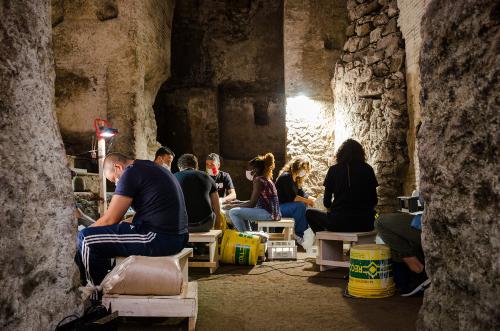
Presented in 2020 at the Augusteo Aqueduct of Serino in Rione Sanità, Naples, Dry Land is a performative and site-specific project conceived by Cuban artist Adrian Melis in collaboration with the local community. Employing foley art, the artist and participants skillfully (re)evoke the presence of the water that once coursed through the now-disused aqueduct, using an array of everyday objects to generate sounds. Presence and absence, contemplative function versus productive function, past materiality, and present immateriality are among the elements that distinguish this work, seamlessly aligning with Melis' artistic and sociopolitical practice.
In Dry Land, the power of sound as a social adhesive between a territory (or its remnants) and its inhabitants emerges with crystal clarity. Melis' sound installation serves as a vessel for collective memory, not passively received from the past, but consciously chosen in the present. The intangibility of the sounds, though not yielding a tangible product, effectively reactivates new processes of identity construction. Hands and objects thus become unexpected acoustic entities, assuming the roles of protagonists in a collective concert. Within each individual sound creation, people make choices on how and which aspects of themselves, their traditions, and their past values to transmit and perpetually revive.
https://vimeo.com/494837110
Courtesy: Collezione Anna e Francesco Tampieri
Details
- TitleTerra Asciutta (Dry Land)
- Author Adrian Melis
- Year 2020
- Classification Video art
- Duration 00:08:33
- Edition 1/5
- Medium video H.264 (1920 x 1080), colore, stereo,
Description
Rione Sanità, Napoli: the artist recreates the noises of the Roman aqueduct (called Acquedotto augusteo del Serino) by asking people hired from this poor area to reproduce the noise of the running water, using the techniques of the Foley artists.
from the artist's website: Engaging in a dialogue with both the remnants of the aqueduct and the people who live and work in the neighbourhood, Adrian Melis, the third artist invited to participate in the ‘Underneath the Arches’ programme, created a production chain meant to reactivate the course of what is no longer there: water. To this end, Melis made use of Foley Art, a technique used in cinema that can reproduce specific sounds using different types of objects. The water that once ran in the channels of the Roman aqueduct, supplying the area completely, is therefore merely evoked and remains absent. In its place, objects collected in the neighbourhood, together with the same walls that delineate the perimeter of the space, become unexpected sound bodies in the hands of local inhabitants, recruited to a specific task: to restore a function for the imposing structure. The artist lived in the neighbourhood for several months, meeting people, entering into the folds of its social dynamics, compounded or revealed with the health emergency. Reflecting on the gap between the ‘active’ and necessary function the aqueduct had in the past and the ‘passive’ and conservative role that the site conserving its remnants has, he involved some of the residents as a workforce, turning a contemplative space into a productive one. In this resolve to rediscover its original function, the aqueduct takes on another one, completely contemporary: instead of a water resource, for a few hours, it becomes a resource for work and social gathering. Therefore, Adrian Melis’ work reflects on the concept of ruin on multiple levels, establishing a link between the remnants visible at the archaeological site and the difficulties of the present. This duality is encapsulated in the title, ‘Terra asciutta’: a dry place due to the absence of water, and the absence of structure and security, from which alternative forms of work that use creativity and ingenuity as raw materials arise. The artist becomes an activator of a process already underway in the neighbourhood and in the city, recreating a workplace, a half-hidden, alive and dynamic workshop, and equipped with all the necessary tools for carrying out the set task. Each worker finds his/her own place, working hard to achieve a common goal: trace and reproduce the sound as faithful to water as possible, handling material while aspiring to an intangible product like sound. The soundtrack that resonates in the space once the workers have left their stations is the memory of a collective act that conserves the evidence of human presence just as the objects left in this temporary workshop do, clues that reveal the process with which the ancient aqueduct returned, almost magically, to live in the present.
text by Alessandra Troncone and Chiara Pirozzi
Exhibitions
"Cinema" group exhibition, ArtVerona, 9-11 Oct. 2026.
Bibliography
Barrientos, R.-M., A. Troncone, and A. Venäläinen, 2021: The Paradox of Labour. A reader on the work of Adrian Melis, Pori Art Museum, adn galeria, pag. 96
© the author
All material, images, drawings, software, distinctive trademarks contained in this site are protected by Italian Laws and by International Treaties regarding copyrights and may not be reproduced, distributed, displayed or published without permission. For more details see
Terms & Conditions.
Return to exhibition